

Neurons
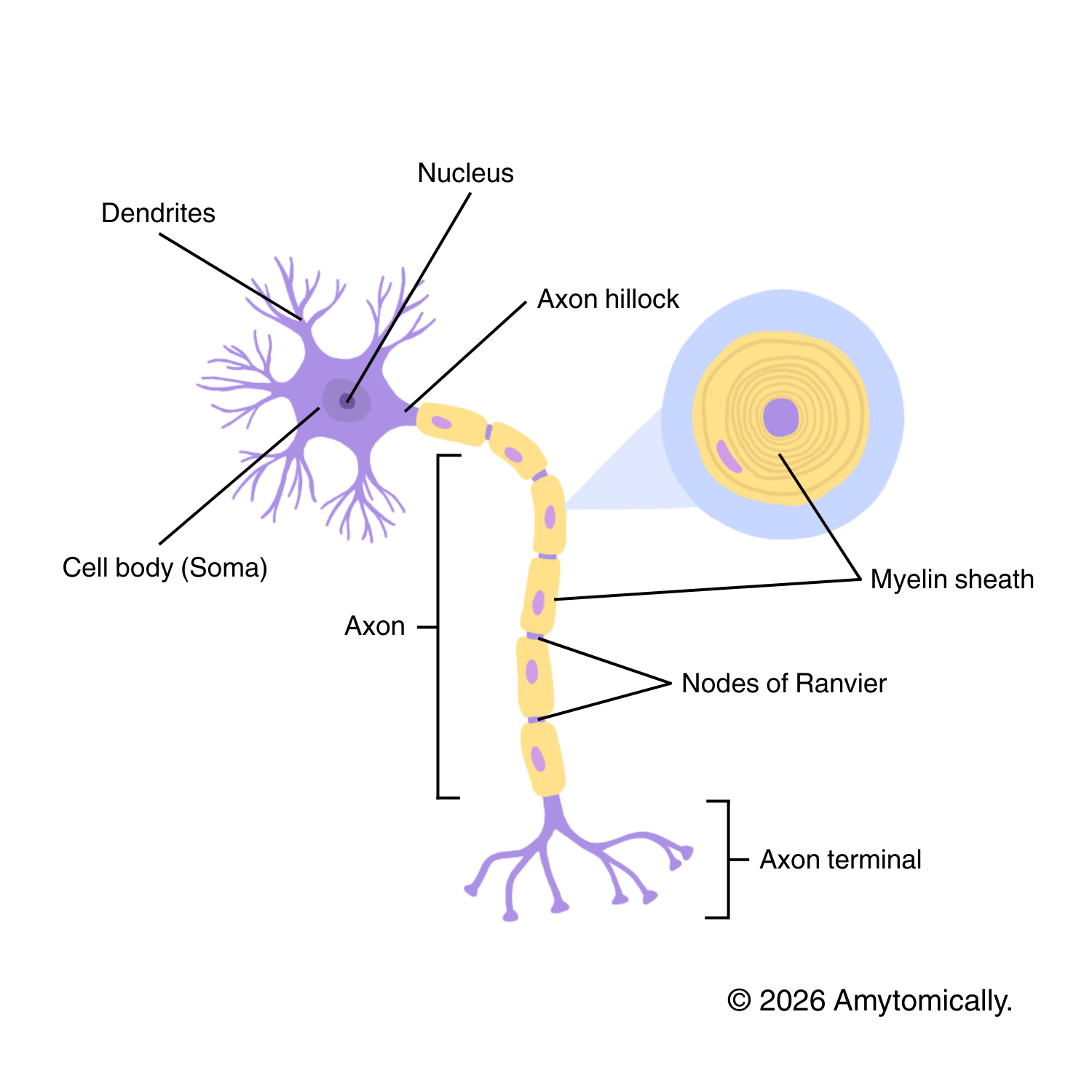
Neurons facilitate communication within and between various tissues/organs, our central processing centers (i.e., our brain and spinal cord), or locally, via reflex arcs
- High metabolic demands
- Are arrested in G0 (do not undergo mitotic division or regeneration)
Key components
- Dendrites (or dendritic spines): projections that receive electrical or chemical impulses
- Cell body (Soma or Perikaryon): houses the cellular nucleus and organelles needed for metabolic functions
- Contains basophilic Nissl bodies in the cytoplasm (masses of rough endoplasmic reticulum)
- Axon: a long process that extends from the axon hillock to the axon terminal, conducting the electrical impulse along its length
- Axolemma (axonic plasma membrane)
- Axoplasm (axoic cytoplasm)
- Collaterals (axonic branches)
- Telodenndria (axonic ends)
- Myelin sheath (see below)
Nomenclature
- Collection of somas: nuclei (CNS) vs ganglia (PNS)
- Bundles of axonic fibers: tracts (CNS) vs nerves/nerve fibers (PNS)
Myelin sheath
Myelin: compacted plasma membrane (lipid-rich) layers created by the concentric wrapping of oligodendrocytes (CNS) or Schwann cells (PNS), where electrical impulses are regenerated
- Oligodendrocytes can myelinate multiple portions, while Schwann cells can only myelinate one portion of the axon
- Nodes of Ranvier: nodal gaps between myelinated regions, which the impulse “skips” in saltatory conduction
Neuron classification: Structural
Multipolar: singular axon, multiple dendrites; most common, especially in CNS
Bipolar: singular axon and dendrite; rare, seen in specialized sensory tissue (retina, olfactory epithelium, auditory nerves)
Unipolar/Pseudounipolar: single central axon with a single short process attached to the soma; afferent sensory ganglia
Anaxonic: consisting only of dendrites and a soma; serve regulatory function
Axon fibers
| Type of axon | Size & Myelination | Subdivisions | Function |
|---|---|---|---|
| Type A (fastest) | Medium-large, myelinated | Aα, Aβ, Aγ, Aδ | Proprioception/stretch, motor commands |
| Type B (intermediate) | Medium, myelinated | N/A | ANS commands (pre-ganglionic fibers) |
| Type C (slowest) | Smallest, unmyelinated | N/A | Aching pain, temperature, itch (postganglionic fibers) |
 Amytomically
Leave a comment