

Bone Composition and Organization
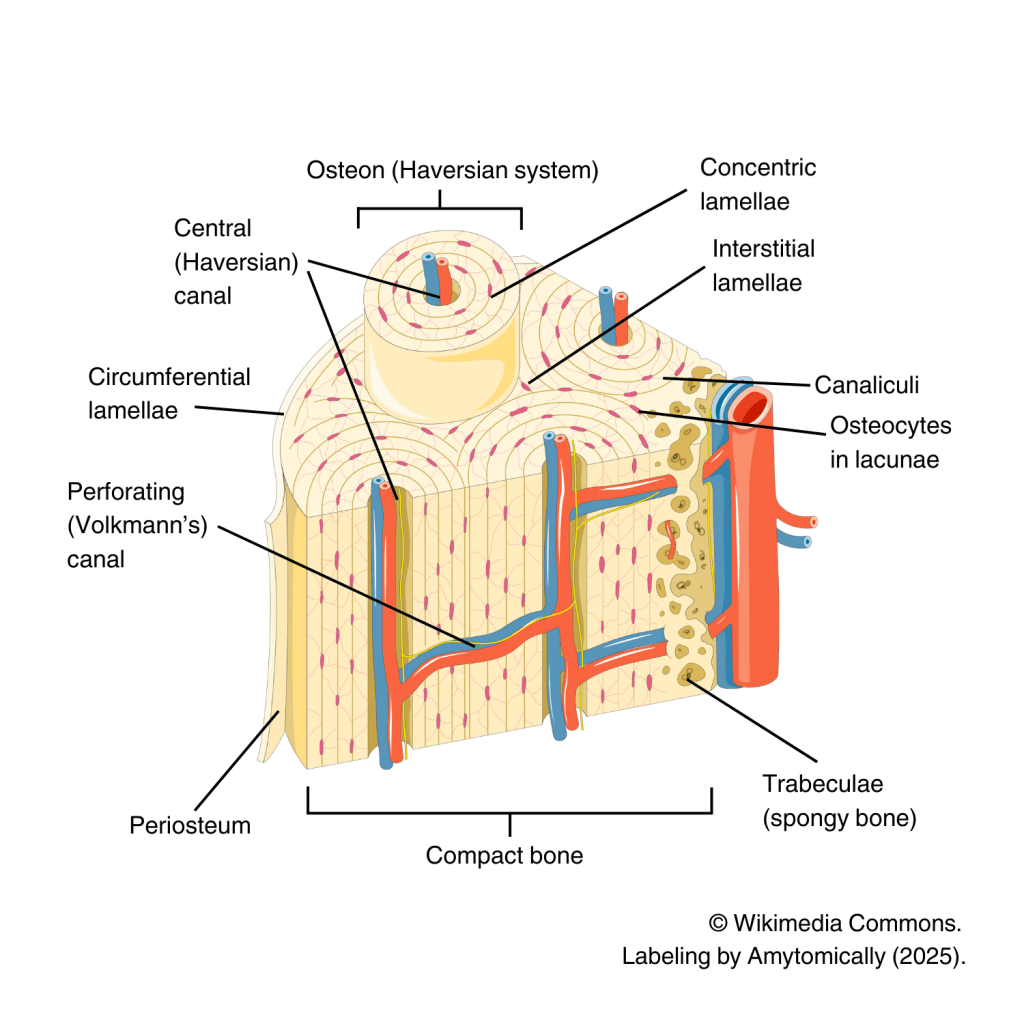
Bone Matrix
Bone matrix has both organic (30%) and inorganic components (70%)
Organic components
- Main function: soft, resisting tension
- Cells: osteoclasts, osteoblasts, osteocytes
- Osteoid: ground substance (proteoglycans, T1 collagen, CT)
- Trace minerals: F-, Cl-, K+, Mg2+
Inorganic components:
- Main function: hard, resisting compression
- Hydroxyapatite crystals (Ca₁₀(PO₄)₆(OH)₂)
Compact & Spongy Bone
Compact bone organization (aka cortical bone)
Osteons: cylindric structures placed concentrically around each other
Lamellae
- Concentric lamellae: concentric layers of osteons
- Interstitial lamellae: between concentric lamellae, fill in gaps or are derivatives of old osteons
- Circumferential lamellae: lamellae around the order border of bones (beneath the periosteum)
Why lamellae? The fibers of each lamellae are parallel, but fibers of adjacent lamellae are alternating, thus providing an additional later of torsional resistance
Canals
- Central (Haversian) canal: within each osteon
- Perforating (Volkmann’s) canal: perpendicular to central canal, connect vascularization of compact bone to medullary cavity/spongy bone
Lacunae: small cavities at lamellar junctions where osteocytes reside and sense bone matrix composition
Canaliculi
- Passages between lacunae filled with fluid; facilitate communication between osteocytes in an osteon and regulate the transportation nutrients/waste
- How do canaliculi form? They are formed from the remnants of osteoblast cytoplasmic extensions who got trapped in osteoid
Spongy bone organization (aka cancellous bone)
No osteons
Trabeculae: porous network, contains irregular lamellae with osteocytes


Leave a reply to Bone Cells and Remodeling – Amytomically Cancel reply