

Vitiligo
General Information
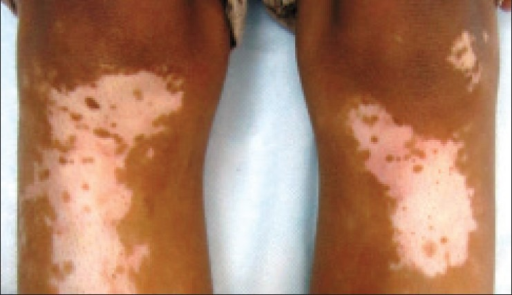
What is it?
Acquired, primary autoimmune depigmentation with no secondary cause
Risk Factors: *thyroid disease or abnormalities, Addison’s disease, Type 1 Diabetes Mellitus, family history
Classification
- Clinical variants: trichrome, marginal inflammatory, quadrichrome, leukotrichia
- Trichrome: 3 shades (normal, hypopigmentation, depigmentation)
- Marginal inflammatory: erythematous borders
- Quadrichrome: 4 shades (trichrome but with hyperpigmented rim)
- Leukotrichia: white hair in patch (Figure 2)
- Pattern distribution: generalized/vulgaris, segmental, localized/focal, universal
- Vulgaris: most common distribution
- Segmental: unilateral, dermatomal, stable, early-onset
- Focal: isolated and localized patches
- Universal: 80-90% of body is depigmented
Evaluation
Signs & Symptoms
- White macules and patches that tend to be symmetric/bilateral
- Well demarcated, convex borders
- Macule (flat, <10mm dia) vs patch (>10mm dia)
- Can be pruritic or tingling
- Occur mostly around extensor surfaces, periorificial areas
- Koebner phenomenon: onset of new lesions in areas of cutaneous injury or treatment (in 20-60% of patients)
- Chorioretinitis: choroid/retinal inflammation
Wood lamb: can help differentiate vitiligo from other pigmentation conditions
Pathophysiology & Etiology
Melanocyte loss/destruction
- Could be due to cytotoxicity, autoimmunity, oxidant mechanisms
Genetic predisposition
- Incomplete penetrance, multiple susceptibility loci
- Affects genes regulating melanin production, autoantibodies
Complications

Much higher rate of UV-related disease incidence: sunburn, skin cancer
Hearing loss: loss of cochlear melanocytes
Iritis: inflammation of eye iris
Treatment
To protect against UV damage and skin-related complications: SPF, narrow band UVB therapy 2-3x/week (to prevent melanocyte destruction)
Topical treatment: corticosteroids, calcineurin inhibitors
Phototherapy
Surgical treatment options (for segmental or localized vitiligo): grafts, epidermal suspensions
 Amytomically
Leave a comment