

Atopic Dermatitis (Eczema)
General Information
What is it?
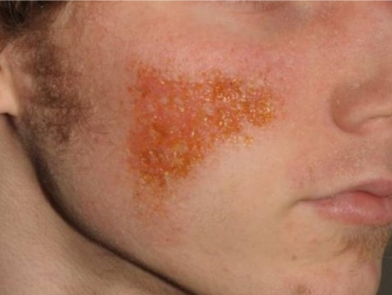
Chronic, autoimmune, pruritic, inflammatory skin disease that is relatively common (affects 5-20% children worldwide)
Presents with dry, itchy skin rashes/lesions that become more localized with age
Rash distribution: nonspecific distribution in children → primarily affects skin creases and flexure surfaces (i.e. inner elbows, backs of knees) which contrasts psoriasis (extensor surfaces)
Risk Factors: genetic predisposition (e.g. filaggrin [see below]), environmental allergic triggers (e.g. detergents, soaps, dust mites), correlation with food-related allergies such as eggs, milk, and peanuts, water hardness (calcium carbonate)
Evaluation:
- Atopic triad: atopic dermatitis also presents with allergic rhinitis and asthma (strong association between all three, 80% of individuals with atopic dermatitis will develop either or both allergic rhinitis/asthma)
- Symptoms improve in humid conditions, as moisture retainment is increased
- Could present with lichenification or Dennie-Morgan lines (crease-like wrinkles below lower eyelid)
Atopic Stigmata
What are they? Characteristics unrelated to atopic dermatitis that may indicate genetic predisposition/increased susceptibility to related allergens
Dennie Morgan Fold (wrinkling under eyes), Hertoghe’s Sign (thinning or absence of lateral eyebrow), Keratosis Pilaris (chicken skin), Palmar Hyperlinearity (many more palmar lines), Pityriasis Alba (whitening of certain parts of body), Retroauricular Fissuring (chaffing behind the ear)
Pathophysiology:
- *Mutations in filaggrin gene (FLG)
- Filaggrin aggregation leads to the creation of hygroscopic molecules (e.g. carboxylic acid, lactic acid, uric acid) that draw water and retain moisture
- When this process is affected by mutations, the epidermal barrier may be defective, leading to greater susceptibility to environmental triggers or allergens
- Protease/antiprotease activity imbalance (kallikrein vs LEKTI)
- Tight junction abnormalities
- Immune dysregulation
- Involvement of interleukins IL-4, IL-13, IL-31
- Decreased toll-like receptors TLR-2, TLR-9
- Increased expression of TH2, TH17, TH22 helper T cells
- Reduced B-defensins in the skin: increased likelihood of colonization and infection
Treatment
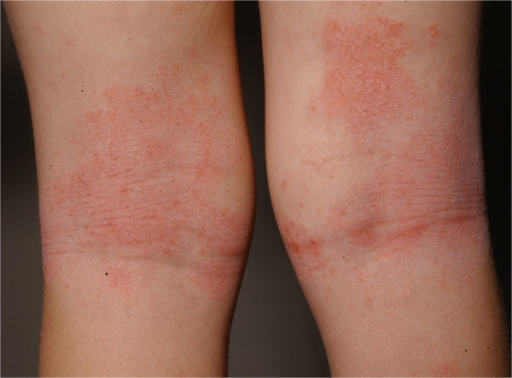
Protective factors: more exposure to antigens/allergens early on (i.e. through daycare, farms)
Daily moisturizing regimen
Avoid allergens/triggers, including fragrances, nonbreathable fabrics
Reduce stress/anxiety
Topical corticosteroids (2.5% hydrocortisone)
Topical calcineurin inhibitors (less damaging than topical corticosteroids)
Limited usage cyclosporine for flare ups
 Amytomically
Leave a comment